

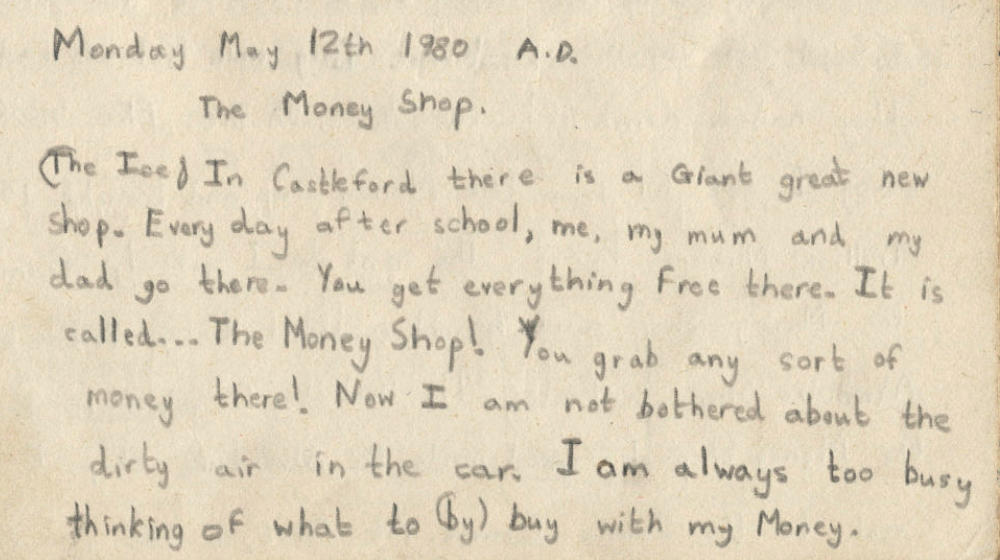
In May 1980, the National Union of Journalists called a strike at publisher IPC. This meant my
favourite comic, 2000 AD, was taken off the shelves for five whole weeks. I assume this is
why I started reading my old comics again - which is what I must have been doing when I
wrote this story.
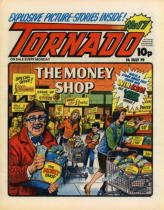
‘The Money Shop’ was an idea I ripped from the cover of Tornado No 17, which had a cover
date of July 14, 1979 - just a couple of months before I arrived in Fairburn. But it wasn’t just
theft on my part. The cover was an invitation to enter a competition called It’s Your Turn. All I
had to do was write a story called The Money Shop and send it in. The writer of the best one
would not only win the £20 cash prize, but also see their story printed in Tornado itself! I’ve
no idea how favourably £20 stacked up against the usual fee for a couple of pages in a comic
back in those days, but it sounded like a good deal to me. Imagine how many issues of
Tornado I could buy!
Sadly, Tornado folded five weeks later, so as far as I know the winner was never announced,
and naturally I would have known we were long past the deadline. But that didn’t stop me
wanting to win. I was determined to write the best story I could manage. Maybe this idea -
the Money Shop - would finally reveal me as the master scribe I knew I was destined to
become.
What it actually revealed was raw, untempered avarice - a freewheeling fantasy of
stupendous acquisitiveness that lays my young self’s deepest desires bare on a plate: a
world in which everything is free. You don’t just get free money in this story - it’s pretty much
free everything. Yes, you have to pay for the toys and consumer goods, but they’re often
cheaper than could possibly be practical, and technologically far superior to anything we’ve
managed to invent in the 43 years since this story was written. And since the money’s just
lying around on shop shelves, I don’t have to pay for any of it.
But I look again and it’s clear this isn’t just a basic lust for money and goods. The money is a
means to an end, and the end isn’t simply to have things. All of these things I buy are
gateways to experience. The Adventure TV allows me to go inside it and participate in an
episode of Blake’s 7. The Adventure Shop (next door?) is itself a gateway to the Jungle Cruise.
Even the robots I buy from the Super Save Store are just there to keep me company for an
afternoon. What I was really craving was a good time, and money’s value was only relative to
how good a time it could buy me.
Underneath all that though, there’s a much darker impulse at work. I wasn’t that violent in
real life, but my imagination was starting to head down quite a vicious road. My goal in this
interactive episode of Blake’s 7 is to murder all the bad guys - especially arch-baddie
Servalan, who specifically gets shot in the heart. The Jungle Cruise is an avalanche of
violence - from the crocodile vomiting itself to death to the ape suddenly appearing from
nowhere just so it can kick me in the guts. Worst of all, in an extraordinary moment of naked
racism I don’t think is parallelled anywhere else in these books, there’s the moment where I
get out my pocket gun (because, you know, obviously I had guns in my pocket) just so I can
murder a Native American (also in the heart - obviously my favourite target). And if that’s not
bad enough, most reprehensibly, I dehumanise them as an “it”.
I’m sure this sprint towards brutality was all about me wanting to write the most exciting
story I could think of, without having any of the necessary skills to make that happen. The
cartoon violence is absolutely inspired by the comics I was reading. But it comes across as a
mad kid suffering from an acute episode of ADHD, and - as my wife (a primary school
teacher) has often said to me - these days I’d probably get flagged up for some kind of
special investigation, just to make sure everything was alright at home.
To be frank, things weren’t alright at home. There was no violence - at least, not yet. My
parents didn’t believe in physical punishment, so I wasn’t accustomed to being hit. But they
weren’t getting on with each other, and that probably had a knock on effect. Whether an
increasingly aggressive imaginary life was part of that, I can’t say. But I’ll explore that idea a
bit more when we get to Part Two.
One thing that genuinely did bother me about my home life is very plainly expressed. I didn’t
like “the dirty air in the car”. Back then, it was still legal to smoke in the same car as a child,
and my parents both smoked. This meant virtually every car journey was a choking hot box
of nicotine, and I absolutely hated it. They found it irritating when I complained, so I learned
not to, but the times we went on holiday with Diane and Wayne - with four adults continually
smoking in the same car as me, occasionally burning me with stray cigarettes when we went
over bumps in the road - were pretty much unbearable.
When I started smoking myself a decade later, I didn’t quite know how to break it to my
Mum. So I didn’t say anything - just pulled out a packet of Marlboro, lit a fag and hoped for
the best. Fearing some kind of tirade or at least mild disapproval, she surprised me by falling
into hysterics. It was brilliantly funny, apparently, that I smoked now, after all that
complaining I used to do at them when I was a kid.
It took me twenty years to kick the habit. That was thirteen years ago so I feel relatively
lucky, but I could have done without spending all that money on it. I could have done
without the thyroid cancer I developed the year afterwards as well, but I can’t blame all that
on the dirty air in the car. Can I?
The Money Shop



Ceremonies
For Sale
School Rules
Football
The Micronauts: The Return of Supersilver
Apeth (frum Ota Sbees)
Exploring the Underworld
When I Was Happiest
Plant Description
The Money Shop: Part 1
The Money Shop: Part 2
Moses and the Pharaoh
Ideas for Sports
The Money Shop: Part 3
Watch: Cocoa
The Horrible Black Friday
Waen Shepherd’s Run
I Do Not Like…
My Wellington Boots
I Am John McEnroe
Police Horses
My Name is Alice
Captain Kremmen: The Cat Soldiers
Andrew’s Body Area
Star Wars: Revenge of the Jedi
Summer
Scaredy Cat Goes to the Dentist’s
Judge Dredd: The Shape Changers
Apeth Returns
The Phantom Strikes Again
Grate Rubbing
Starkiller
Captain Shepherd
The Origin of Tomato Man
Copy Writing & Exercises




INSPIRED BY…



- ENGLISH
- ENGLISH 1
- English 1: Overview
- Clarke Hall
- Old Houses
- Fairburn v Burton Salmon
- The Forgotten World
- String Orchestra
- Sheet Lightning
- Grezelda the Witch
- Bonfire Night
- Metropolitan Police
- Christmas 1979
- Great Space Battles
- Luddenden
- The Hat's Adventure
- Sleeping Beauty
- What I Do On Monday
- Waen Shepherd 2
- Waen Shepherd in: Green Squids
- Ward's 7: Move of the Galaxy
- Ward's 7: Alpha Centauri
- Ward's 7: Escape to Mother Ship
- Ward's 7: Death Planet
- Blake's 7
- Ward's 7: The Hunt
- The Flame in the Desert
- The Fugitive
- British Skiing Events
- Ward's 7: Rescue
- Fiends of the Eastern Front
- Black Hawk Profile
- Apeth
- Tedosaurus
- A Walk in Our Village
- The Mountain Called Tyrannosaurus Rex
- Florence Nightingale
- War of the Worlds
- The Micronauts: Supersilver
- ENGLISH 2


- TOPIC
- TOPIC 1
- TOPIC 2
- Topic 2: Overview
- Dinosaurs 1
- Space Travel
- Ships
- Sport
- Dinosaurs 2
- Judge Dredd: The Blood of Satanus
- Captain Carnivore
- A-Maze-ing!
- Star Poster: Super Jesus
- The Micronauts: Giant Karza
- The Origin of Electro
- Optical Illusion Time
- Frantic Thingies
- Men in Space
- Topic Book Word Find
- Puzzleman
- Evel Knievel: Fury Falls
- More Puzzlers
- Star Poster: The Hulk (1)
- Grobschnitt's Page
- Captain Starlight
- Star Poster: The Hulk (2)
- The Yellyog Gang
- The Adventures of Puzzlemaster
- Jupe
- Woman Line
- Pin-Up: Doctor Doom
- Lazer Lash
- The Human Maze
- Three Squares
- Raven Mad
- Marvel Sketches
- Robschnitt's Age: 1
- Snotty Notty


- AND THE REST: An overview
- ODDS & ENDS
- HISTORY 1
- History 1: Overview
- People in the Old Stone Age 1
- Guy Fawkes
- People in the Old Stone Age 2
- People in the Old Stone Age 3
- The New Stone Age
- People of the Bronze Age
- The Story of Nelson 1
- The Story of Nelson 2
- The Story of Nelson 3
- Florence Nightingale
- The Story of Nelson 4
- The Story of Nelson 5
- The Story of Nelson 6
- The Story of Nelson 7
- SCIENCE 1
- GEOGRAPHY 1
- BIOGRAPHICAL NOTES


The Money Shop


In May 1980, the National Union of Journalists called
a strike at publisher IPC. This meant my favourite
comic, 2000 AD, was taken off the shelves for five
whole weeks. I assume this is why I started reading
my old comics again - which is what I must have
been doing when I wrote this story.
‘The Money Shop’ was an idea I ripped from the
cover of Tornado No 17, which had a cover date of
July 14, 1979 - just a couple of months before I
arrived in Fairburn. But it wasn’t just theft on my
part. The cover was an invitation to enter a
competition called It’s Your Turn. All I had to do was
write a story called The Money Shop and send it in.
The writer of the best one would not only win the
£20 cash prize, but also see their story printed in
Tornado itself! I’ve no idea how favourably £20
stacked up against the usual fee for a couple of
pages in a comic back in those days, but it sounded
like a good deal to me. Imagine how many issues of
Tornado I could buy!
Sadly, Tornado folded five weeks later, so as far as I
know the winner was never announced, and
naturally I would have known we were long past the
deadline. But that didn’t stop me wanting to win. I
was determined to write the best story I could
manage. Maybe this idea - the Money Shop - would
finally reveal me as the master scribe I knew I was
destined to become.
What it actually revealed was raw, untempered
avarice - a freewheeling fantasy of stupendous
acquisitiveness that lays my young self’s deepest
desires bare on a plate: a world in which everything
is free. You don’t just get free money in this story -
it’s pretty much free everything. Yes, you have to pay
for the toys and consumer goods, but they’re often
cheaper than could possibly be practical, and
technologically far superior to anything we’ve
managed to invent in the 43 years since this story
was written. And since the money’s just lying around
on shop shelves, I don’t have to pay for any of it.
But I look again and it’s clear this isn’t just a basic
lust for money and goods. The money is a means to
an end, and the end isn’t simply to have things. All of
these things I buy are gateways to experience. The
Adventure TV allows me to go inside it and
participate in an episode of Blake’s 7. The Adventure
Shop (next door?) is itself a gateway to the Jungle
Cruise. Even the robots I buy from the Super Save
Store are just there to keep me company for an
afternoon. What I was really craving was a good
time, and money’s value was only relative to how
good a time it could buy me.
Underneath all that though, there’s a much darker
impulse at work. I wasn’t that violent in real life, but
my imagination was starting to head down quite a
vicious road. My goal in this interactive episode of
Blake’s 7 is to murder all the bad guys - especially
arch-baddie Servalan, who specifically gets shot in
the heart. The Jungle Cruise is an avalanche of
violence - from the crocodile vomiting itself to death
to the ape suddenly appearing from nowhere just so
it can kick me in the guts. Worst of all, in an
extraordinary moment of naked racism I don’t think
is parallelled anywhere else in these books, there’s
the moment where I get out my pocket gun
(because, you know, obviously I had guns in my
pocket) just so I can murder a Native American (also
in the heart - obviously my favourite target). And if
that’s not bad enough, most reprehensibly, I
dehumanise them as an “it”.
I’m sure this sprint towards brutality was all about
me wanting to write the most exciting story I could
think of, without having any of the necessary skills
to make that happen. The cartoon violence is
absolutely inspired by the comics I was reading. But
it comes across as a mad kid suffering from an acute
episode of ADHD, and - as my wife (a primary school
teacher) has often said to me - these days I’d
probably get flagged up for some kind of special
investigation, just to make sure everything was
alright at home.
To be frank, things weren’t alright at home. There
was no violence - at least, not yet. My parents didn’t
believe in physical punishment, so I wasn’t
accustomed to being hit. But they weren’t getting on
with each other, and that probably had a knock on
effect. Whether an increasingly aggressive imaginary
life was part of that, I can’t say. But I’ll explore that
idea a bit more when we get to Part Two.
One thing that genuinely did bother me about my
home life is very plainly expressed. I didn’t like “the
dirty air in the car”. Back then, it was still legal to
smoke in the same car as a child, and my parents
both smoked. This meant virtually every car journey
was a choking hot box of nicotine, and I absolutely
hated it. They found it irritating when I complained,
so I learned not to, but the times we went on
holiday with Diane and Wayne - with four adults
continually smoking in the same car as me,
occasionally burning me with stray cigarettes when
we went over bumps in the road - were pretty much
unbearable.
When I started smoking myself a decade later, I
didn’t quite know how to break it to my Mum. So I
didn’t say anything - just pulled out a packet of
Marlboro, lit a fag and hoped for the best. Fearing
some kind of tirade or at least mild disapproval, she
surprised me by falling into hysterics. It was
brilliantly funny, apparently, that I smoked now,
after all that complaining I used to do at them when
I was a kid.
It took me twenty years to kick the habit. That was
thirteen years ago so I feel relatively lucky, but I
could have done without spending all that money
on it. I could have done without the thyroid cancer I
developed the year afterwards as well, but I can’t
blame all that on the dirty air in the car. Can I?


- ENGLISH
- ENGLISH 1
- English 1: Overview
- Clarke Hall
- Old Houses
- Fairburn v Burton Salmon
- The Forgotten World
- String Orchestra
- Sheet Lightning
- Grezelda the Witch
- Bonfire Night
- Metropolitan Police
- Christmas 1979
- Great Space Battles
- Luddenden
- The Hat's Adventure
- Sleeping Beauty
- What I Do On Monday
- Waen Shepherd 2
- Waen Shepherd in: Green Squids
- Ward's 7: Move of the Galaxy
- Ward's 7: Alpha Centauri
- Ward's 7: Escape to Mother Ship
- Ward's 7: Death Planet
- Blake's 7
- Ward's 7: The Hunt
- The Flame in the Desert
- The Fugitive
- British Skiing Events
- Ward's 7: Rescue
- Fiends of the Eastern Front
- Black Hawk Profile
- Apeth
- Tedosaurus
- A Walk in Our Village
- The Mountain Called Tyrannosaurus Rex
- Florence Nightingale
- War of the Worlds
- The Micronauts: Supersilver
- ENGLISH 2


- TOPIC
- TOPIC 1
- TOPIC 2
- Topic 2: Overview
- Dinosaurs 1
- Space Travel
- Ships
- Sport
- Dinosaurs 2
- Judge Dredd: The Blood of Satanus
- Captain Carnivore
- A-Maze-ing!
- Star Poster: Super Jesus
- The Micronauts: Giant Karza
- The Origin of Electro
- Optical Illusion Time
- Frantic Thingies
- Men in Space
- Topic Book Word Find
- Puzzleman
- Evel Knievel: Fury Falls
- More Puzzlers
- Star Poster: The Hulk (1)
- Grobschnitt's Page
- Captain Starlight
- Star Poster: The Hulk (2)
- The Yellyog Gang
- The Adventures of Puzzlemaster
- Jupe
- Woman Line
- Pin-Up: Doctor Doom
- Lazer Lash
- The Human Maze
- Three Squares
- Raven Mad
- Marvel Sketches
- Robschnitt's Age: 1
- Snotty Notty


- AND THE REST: An overview
- ODDS & ENDS
- HISTORY 1
- History 1: Overview
- People in the Old Stone Age 1
- Guy Fawkes
- People in the Old Stone Age 2
- People in the Old Stone Age 3
- The New Stone Age
- People of the Bronze Age
- The Story of Nelson 1
- The Story of Nelson 2
- The Story of Nelson 3
- Florence Nightingale
- The Story of Nelson 4
- The Story of Nelson 5
- The Story of Nelson 6
- The Story of Nelson 7
- SCIENCE 1
- GEOGRAPHY 1
- BIOGRAPHICAL NOTES